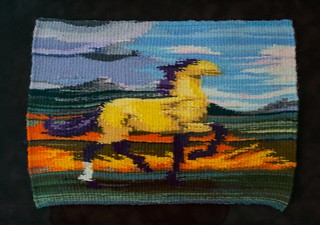
One of the things about being a new grad is that it takes a while for it all to sink in--you've crossed the finish line--but there's so much work to do. In my case, I've spent the last few months cleaning, organizing, donating and recycling where I can. It's nice to not have to step over things and vacuum the carpet. Best of all, I get to make art for myself again. If you have been following my Facebook page or my blog for some time, you know I was a regular entrant to the Calgary Stampede Western Lifestyle Arts and Crafts Show. The show is a quiet, dim respite from the excitement of the fairgrounds but also a great place to see local talent from cakes to quilts.
I wasn't sure I would be able to complete an entry before the end of the semester and the June 20th deadline. It's probably true for a lot of grads, but once the semester was done, I was done. I could not make anything and the pressure was on. Instead of worrying about what the finished item would look like, I just simply got started!
About ten years ago I was making miniature tapestries with embroidery floss and revisited the tapestry idea by snapping a piece of aida cloth into a small embroidery hoop. Strand by strand, the landscape began to take place. Click on any photo for a larger view.
Making a mountain was the hardest part. I used a wedge of cardstock to weave the sky around it.
Once the tapestry was done, it got a haircut and a layer of glue around the edges.
Then it was time to make the front. I printed my drawing, "Little Horse on the Prairie", onto a piece of cardstock, snip snip snipped and assembled! There was no way I could weave the horse in on such a small scale. I was already having trouble seeing and ended up buying clip-on magnifiers for my glasses.
My frenzied work paid off because I won third place! My friend Luba kindly shared the news. Regrettably I did not get out to the Stampede this year to see the other works.0 I'll definitely be back at the show next year with something bigger and horse-related, I'm sure :-)
Showing posts with label fibre. Show all posts
Saturday, August 27, 2022
Sunday, April 24, 2022
Somewhere around Week 12...
For my final Tuesday class project, I did a small installation with a photograph. I would love to do larger prints of the photograph. However, 9x12 was the largest size guaranteed by the photo lab for next day printing. Ah, art students! Some things never change no matter how old a student you are ;-D In reality, waiting for the light to be just right was tedious. There were many overcast, spring days where the right just wasn't right.
Time to Bloom is inspired by a genre of still life painting called vanitas which was popular in 17th century Netherlands. Usually they feature haphazard composition, signs of wealth and signs of mortality such as skulls. Mine is much more toned down and humble. For example, below is a vanitas (titled "Vanitias" by Pieter Boel and Jacob Jordaens):
My photo wasn't as cluttered. Some things I wanted to include I simply could not find around the house either, doh! I could see making more photos like this though. Our personal objects and homes say a lot about us, whether we realize it or not. Additionally, vanitas paintings are often coded--a skull may represent death and mortality, books could indicate knowledge and gold, of course, wealth. It took 169 photos to pick the perfect one, by the way, and I chose five for printing.
Here's a close-up of just the photo:
Time to Bloom is inspired by a genre of still life painting called vanitas which was popular in 17th century Netherlands. Usually they feature haphazard composition, signs of wealth and signs of mortality such as skulls. Mine is much more toned down and humble. For example, below is a vanitas (titled "Vanitias" by Pieter Boel and Jacob Jordaens):
My photo wasn't as cluttered. Some things I wanted to include I simply could not find around the house either, doh! I could see making more photos like this though. Our personal objects and homes say a lot about us, whether we realize it or not. Additionally, vanitas paintings are often coded--a skull may represent death and mortality, books could indicate knowledge and gold, of course, wealth. It took 169 photos to pick the perfect one, by the way, and I chose five for printing.
Here's a close-up of just the photo:
Thursday, August 12, 2021
Catching Up! ACAD310 Rehearsal
Just in time for #throwbackthursday, here's one of my projects from ACAD310. This was a Monday class, so in some ways it was good to get it out of the way for the rest of the week and other days it was like, this is too early on a Monday morning :-D
The theme of this assignment was rehearsal. As creative people, and really anyone, it takes many hours of training and rehearsal to perfect your craft, hobby or sport. A lot of that work is unpaid, invisible and often lost to mistakes. Would you believe that I have been working on a shawl pattern for years? Sometimes the idea you envision just won't be made or it's not the right time.
Here's the current in-progress picture on the knitting loom:
But, long before I started that, I made woven samples because I thought I would be weaving a shawl. I loved the yarn, James C. Brett Marble Chunky. You can see from the samples that different effects are reached by beating hard and beating gently. I mounted the samples to canvas to elevate them. Samples often just sit around, dusty and forgotten, but this way they can be viewed and appreciated.
The theme of this assignment was rehearsal. As creative people, and really anyone, it takes many hours of training and rehearsal to perfect your craft, hobby or sport. A lot of that work is unpaid, invisible and often lost to mistakes. Would you believe that I have been working on a shawl pattern for years? Sometimes the idea you envision just won't be made or it's not the right time.
Here's the current in-progress picture on the knitting loom:
But, long before I started that, I made woven samples because I thought I would be weaving a shawl. I loved the yarn, James C. Brett Marble Chunky. You can see from the samples that different effects are reached by beating hard and beating gently. I mounted the samples to canvas to elevate them. Samples often just sit around, dusty and forgotten, but this way they can be viewed and appreciated.
Thursday, July 15, 2021
TBT--Festival of Quilts
TBT! I really miss seeing all the lovely quilts and hangings on display at Heritage Park--fingers crossed I can go back in 2022. While many arts organizations have found new audience by going virtual, and it's great, nothing beats seeing quilts wafting in the wind and being able to see them up close.
Monday, December 21, 2020
FIBRE 300 - Fosshape
My art college, AU Arts, has done a great job of keeping students connected while beingn apart. There are some things I miss about being in class with others like spontaneous ideas and peeking over shoulders and wandering hallways. I miss networking with my fellow students, but we're still getting plenty of time to chat in small groups. I learned about a thermoplastic called Fosshape during one of these chats. There's a bit of a learning curve ahead, but I was blown away by how cool it is. There's also another product made by the same company called Wonderflex. The best part is that I can buy it at a theatre shop in my end of town even though it's a bit pricey. I thought I would use it for the third project, but didn't. Who knows down the road though?
Saturday, December 19, 2020
FIBRE 300 - Project 2 Ornamentation
I can't believe I have to go so far back to log this project. Sitting down was a luxury this semester and there's still some more projects to go. For project 2 we had to create an ornament of some sort. Some classmates made hair pieces, some made jewellery and others did ornamentation on fabric. With the art college closed, it was a challenge if you don't have a home studio set up. I didn't even have time to order the materials I wanted to use because the mail is so slow these days. I wanted to buy proper soutache braid, which is a thin flexible braid found on uniforms and such. I blogged about the technique for making soutache jewellery in my last post.
I opted for "fake soutache" with nylon cord. I wanted to use a nicer focal bead or piece of glass, but I was limited to what was in the craft stash and what I could buy at Michaels. It's a little embarrassing how much glue I used. I wanted to make a pin, but I ended up making a picture instead by mounting it on heavy duty black felt. The figure was made from layers of felt and built up.
This feels like a protoype for me. I would do it much differently a second time around. I would make the base from thick cardboard or hobby wood so that it would have enough structure to be used as a pin instead of being floppy. I would commission a bead artist to make me a beautiful custom bead too.
I opted for "fake soutache" with nylon cord. I wanted to use a nicer focal bead or piece of glass, but I was limited to what was in the craft stash and what I could buy at Michaels. It's a little embarrassing how much glue I used. I wanted to make a pin, but I ended up making a picture instead by mounting it on heavy duty black felt. The figure was made from layers of felt and built up.
This feels like a protoype for me. I would do it much differently a second time around. I would make the base from thick cardboard or hobby wood so that it would have enough structure to be used as a pin instead of being floppy. I would commission a bead artist to make me a beautiful custom bead too.
Sunday, December 6, 2020
FIBRE 300--My Fake Soutache
I can't believe I have to go so far back to log this project. Sitting down was a luxury this semester. For project 2 we had to create an ornament of some sort. Some classmates made hair pieces, some made jewellery and others did ornamentation on fabric. With the art college closed, it was a challenge if you don't have a home studio set up. I didn't even have time to order the materials I wanted to use because the mail is so slow these days. I wanted to buy proper soutache braid, which is a thin flexible braid found on uniforms and such. Here's a quick video tutorial on soutach.
I could have mimicked the look with oven bake clay, but I couldn't risk it with pet birds. I opted for "fake soutache" with nylon cord. I wanted to use a nicer focal bead or piece of glass, but I was limited to what was in the craft stash and what I could buy at Michaels. It's a little embarrassing how much glue I used. I wanted to make a pin, but I ended up making a picture instead by mounting it on heavy duty black felt. The figure was made from layers of felt and built up.
This feels like a protoype for me. I would do it much differently a second time around. I would make the base from thick cardboard or hobby wood so that it would have enough structure to be used as a pin instead of being floppy. I would commission a bead artist to make me a beautiful custom bead too.
I could have mimicked the look with oven bake clay, but I couldn't risk it with pet birds. I opted for "fake soutache" with nylon cord. I wanted to use a nicer focal bead or piece of glass, but I was limited to what was in the craft stash and what I could buy at Michaels. It's a little embarrassing how much glue I used. I wanted to make a pin, but I ended up making a picture instead by mounting it on heavy duty black felt. The figure was made from layers of felt and built up.
This feels like a protoype for me. I would do it much differently a second time around. I would make the base from thick cardboard or hobby wood so that it would have enough structure to be used as a pin instead of being floppy. I would commission a bead artist to make me a beautiful custom bead too.
Wednesday, November 11, 2020
FIBRE 300 - Today's discount art lesson
Here are two videos we have to watch for this week's reading response in class.
Friday, October 9, 2020
FIBRE 300--Today's discount art history lesson ;-D
FIBRE 300 is all about the history of ornamentation and now we're on to project 2--jewelry! Here are two videos we have to watch for next week courtesy of The British Museum. I love that the videoes dive into material culture--how people create and use objects is endlessly fascinating.
Sunday, September 6, 2020
My Ultimate Sweater Machine Diary
If you missed a recent post, I bought a Bond American Ultimate Sweater Machine! It's a 100 needle flat knitting machine and it's actually a little tricky to master. I explain how and why in my first video diary.
Tuesday, August 11, 2020
Unboxing Something New and Fun!
It is new, it is fun and to be honest, it is a little frustrating, but I know it's all part of the learning curve. Check out my unboxing of my latest piece of business equipment!
Saturday, June 6, 2020
Gimme A B! Plus!
I really can't believe it's June. It's like time is broken in my brain. I really have to work hard on knowing what day it is, so I'm checking my ACAD webmail feverishly so I don't miss out on registration for next semester. This is w-i-l-d, but all classes will be online! This is something I wanted so badly. The technology has always existed--the will to use it has not. I would have been done my degree a lot faster. Anyway, I'm excited to see what I can take.
I was a few points short of a A in my textiles class, but a B+ is pretty nifty. The class taught me that I needed to upgrade my technical sewing skills if I want to do really well. Oddly enough, you'd be surprised at how much in the way of skill art college doesn't teach you sometimes ;-D Maybe I can take an online sewing class or just practice more on the machine.
I picked up my locker contents yesterday. Access to the college is still closed, but the bookstore is doing curbside pick up. Happily I only had a sweater, a hairbrush and my two projects to pick up. Less is more when it comes to lockers and I'm sure security was thankful they didn't have any moldy food or other ungodly things to do with for me!
I was a few points short of a A in my textiles class, but a B+ is pretty nifty. The class taught me that I needed to upgrade my technical sewing skills if I want to do really well. Oddly enough, you'd be surprised at how much in the way of skill art college doesn't teach you sometimes ;-D Maybe I can take an online sewing class or just practice more on the machine.
I picked up my locker contents yesterday. Access to the college is still closed, but the bookstore is doing curbside pick up. Happily I only had a sweater, a hairbrush and my two projects to pick up. Less is more when it comes to lockers and I'm sure security was thankful they didn't have any moldy food or other ungodly things to do with for me!
Saturday, March 28, 2020
FIBR300 - Love Letter to a Textile
One assignment that could be turned into a take home assignment was Love Letter to a Textile. We often have intimate relationships with our clothing whether we realize it or not. This is all wrapped up in the concept of material culture--how humans consume, use, develop and dispose of objects. Material culture was one of my favourite classes at ACAD/AUArts. It was endlessly fascinating! Once you know about it, you see it in action everywhere.
We see this affection at work when we can't get rid of a child's clothing, hang on to a favourite stuffed animal or wear an article until it can't be mended. We form relationships about how we look, how objects make us feel, reliability and more with clothing (and other objects too!). We would bring in the article, read the letter and have both on display for this assignment.
It was difficult to pick a garment. This assignment would have been a piece of cake at other points in my life. For example, I had a nightshirt that I loved loved as a child because it had a raccoon with glow in the dark eyes on it. When I was a teenager, I loved loved a pair of embroidered jeans. When I was a young adult, I loved loved my flannel sweaters. When I was in my 30s, I loved loved a plaid purple top with big buttons. When I was in my early 40s, I loved loved a smoky purple Coach scarf.
There aren't any garments today where I could say I love love them. I don't know if it's because every day is casual day at my workplace or a matter of middle-age, but all my clothing seems simply functional now.
I decided to go with my oldest piece of clothing that I own--my denim capris. However, I still found it difficult to hit the 500 word mark. Ah well...here we go...
Dear denim capris,
I can't believe we’ve been together longer than I have been married. I remember the first time I saw you at Tabi—it must have been at least twenty years ago—and I was thrilled to find petite denim capris. Petite and plus size? Oh yeah, we were going home together right then and there. It's true you broke the rule of having no pockets on the butt, but that didn't matter. You were perfect enough. In fact, you were absolutely perfect! Nowadays you’re a little faded, but I’m pretty sure you were a robust dark blue. I always preferred dark blue denim.
We have had so many great adventures over the years. We road tripped to Las Vegas twice, flew to Seattle and cruised to Bermuda just to name a few places. Whenever the occasion called for comfortable and casual, you were always there. That is why I loved shopping at Tabi. I knew I could find reliable clothes that looked good, fit well and had a great price. I miss Tabi a lot. I miss shopping there with Mom on weekends, buying fun socks or assembling a look. You remind me of those every day, small moments that were good times too. Maybe you were mass made in a Singapore garment factory, but you are still a unique individual to me!
Denim capris, I thought we would have to part after I lost 40 lbs. You were practically falling off my hips and not very fashionable anymore. You were too worn to thrift yet still too good to throw out. But, then I discovered that you were still functional! You are a perfect fit for winter birdwatching. None of my other jeans will fit over leggings and sweats.
Maybe we don't go out together as much anymore, but you're still perfect to wear around the house. Your colour may be a little faded and your style out of date, but I can still count on you for comfort and covering. And, somehow you don't have any holes anywhere after twenty years of washing and drying. You're a good friend, denim capris! Here’s to another five, ten, maybe twenty years?
Sincerely,
Christine
We see this affection at work when we can't get rid of a child's clothing, hang on to a favourite stuffed animal or wear an article until it can't be mended. We form relationships about how we look, how objects make us feel, reliability and more with clothing (and other objects too!). We would bring in the article, read the letter and have both on display for this assignment.
It was difficult to pick a garment. This assignment would have been a piece of cake at other points in my life. For example, I had a nightshirt that I loved loved as a child because it had a raccoon with glow in the dark eyes on it. When I was a teenager, I loved loved a pair of embroidered jeans. When I was a young adult, I loved loved my flannel sweaters. When I was in my 30s, I loved loved a plaid purple top with big buttons. When I was in my early 40s, I loved loved a smoky purple Coach scarf.
There aren't any garments today where I could say I love love them. I don't know if it's because every day is casual day at my workplace or a matter of middle-age, but all my clothing seems simply functional now.
I decided to go with my oldest piece of clothing that I own--my denim capris. However, I still found it difficult to hit the 500 word mark. Ah well...here we go...
Dear denim capris,
I can't believe we’ve been together longer than I have been married. I remember the first time I saw you at Tabi—it must have been at least twenty years ago—and I was thrilled to find petite denim capris. Petite and plus size? Oh yeah, we were going home together right then and there. It's true you broke the rule of having no pockets on the butt, but that didn't matter. You were perfect enough. In fact, you were absolutely perfect! Nowadays you’re a little faded, but I’m pretty sure you were a robust dark blue. I always preferred dark blue denim.
We have had so many great adventures over the years. We road tripped to Las Vegas twice, flew to Seattle and cruised to Bermuda just to name a few places. Whenever the occasion called for comfortable and casual, you were always there. That is why I loved shopping at Tabi. I knew I could find reliable clothes that looked good, fit well and had a great price. I miss Tabi a lot. I miss shopping there with Mom on weekends, buying fun socks or assembling a look. You remind me of those every day, small moments that were good times too. Maybe you were mass made in a Singapore garment factory, but you are still a unique individual to me!
Denim capris, I thought we would have to part after I lost 40 lbs. You were practically falling off my hips and not very fashionable anymore. You were too worn to thrift yet still too good to throw out. But, then I discovered that you were still functional! You are a perfect fit for winter birdwatching. None of my other jeans will fit over leggings and sweats.
Maybe we don't go out together as much anymore, but you're still perfect to wear around the house. Your colour may be a little faded and your style out of date, but I can still count on you for comfort and covering. And, somehow you don't have any holes anywhere after twenty years of washing and drying. You're a good friend, denim capris! Here’s to another five, ten, maybe twenty years?
Sincerely,
Christine
Wednesday, March 25, 2020
FIBR300 - We interrupt this course...
Life is what happens when you're making other plans. Like so many other students, young and old, my course went online as AU Arts worked in a hurry to ensure continuity for the duration of COVID-19. The university is locked down and I can't access my two large projects.
The last large project was cancelled and I'm kind of grateful for that. I do, however, have one on-going assignment that probably won't go online as it would be difficult. It's the one I'm finishing up now, the cloth journal. I chose a brand new watercolour sketchbook that I had on hand so I didn't have to buy a new one and started dutifully recording mismatched socks, daily clothes habits, laundry schedules, sketches and more.
At the beginning of the semester, I assumed it would become a catalogue of hopes and dreams and new learnings. However, that didn't quite happen. I'm not sure what to learn from this journal. Maybe the time hasn't come to learn from it yet--journals are one of those things that you can look back on and nod sagely.
We still have to submit it by scanning the pages. I photographed the pages and put them in order according to project. My intrinsic sense of order won't quit ;-D
The last large project was cancelled and I'm kind of grateful for that. I do, however, have one on-going assignment that probably won't go online as it would be difficult. It's the one I'm finishing up now, the cloth journal. I chose a brand new watercolour sketchbook that I had on hand so I didn't have to buy a new one and started dutifully recording mismatched socks, daily clothes habits, laundry schedules, sketches and more.
At the beginning of the semester, I assumed it would become a catalogue of hopes and dreams and new learnings. However, that didn't quite happen. I'm not sure what to learn from this journal. Maybe the time hasn't come to learn from it yet--journals are one of those things that you can look back on and nod sagely.
We still have to submit it by scanning the pages. I photographed the pages and put them in order according to project. My intrinsic sense of order won't quit ;-D
Thursday, March 5, 2020
FIBR300: The Upcycling Project - Part 2
There are a lot of considerations when upcycling old textiles. I sketched out a few ideas but I didn't know how feasible it would be. I really liked the look of a t-shirt dress on Pinterest, but I'm not a dress wearing gal. I settled on a shawl.
The next step was to draft a pattern with newsprint. Since my idea was symmetrical, it was super easy to do. I measured out a piece of newsprint the size of half my blanket, drew some feathers, refined the pattern, traced a copy and cut out the pieces after labelling them.
Did you know that t-shirts and polos are not symmetrical, though? The front of the shirt will have slightly less fabric than the back, so you need to consider all the options before you start cutting away. Originally the blue feathers were going to be on the top, but the floral trim on the purple shirt meant that I couldn't get enough fabric for the middle layer. Generally men's clothing will give you more fabric than women's clothing, but I had to find a fourth t-shirt to fill out the design. Before cutting up the shirts, I also had to run the pill shaver over them and clean them up.
To be honest, I wasn't quite sure where I was going. I only had a ~~ vision ~~ of the end product.
The next step was to draft a pattern with newsprint. Since my idea was symmetrical, it was super easy to do. I measured out a piece of newsprint the size of half my blanket, drew some feathers, refined the pattern, traced a copy and cut out the pieces after labelling them.
Did you know that t-shirts and polos are not symmetrical, though? The front of the shirt will have slightly less fabric than the back, so you need to consider all the options before you start cutting away. Originally the blue feathers were going to be on the top, but the floral trim on the purple shirt meant that I couldn't get enough fabric for the middle layer. Generally men's clothing will give you more fabric than women's clothing, but I had to find a fourth t-shirt to fill out the design. Before cutting up the shirts, I also had to run the pill shaver over them and clean them up.
To be honest, I wasn't quite sure where I was going. I only had a ~~ vision ~~ of the end product.
Tuesday, March 3, 2020
FIBR300: The Upcycling Project - Part 1
I have a lot of catching up to do! My class is moving faster than I can document it :-D
Our first homework project was to gather a few pieces of old clothing from our closets or a favourite thrift store. "Upcycling" has been a trend for some time. Old clothing is a fabulous source of fabric or yarn that can be had for free or cheap. It doesn't require new material to be used or purchased. It can be very eco-conscious!
However, there are some caveats. Fast fashion clothing can be so cheaply made that it's not a good candidate for upcycling. High quality clothing usually has a generous seam. Fast fashion items barely have one. Then, thrift shopping has it's own problems with some stores being for-profit and actually expensive. Some chains may actually be a little dodgy--for example, Goodwill was caught underpaying disabled workers in 2013. Lastly, while dropping off old clothes may make someone feel good, there is a chance that they will end up in the rag trade or landfilled (nearshore or offshore). Stores won't take what they can't sell and a lot of clothing just ends up overseas where it can harm local textile economies.
What's a consumer to do? There isn't a perfect answer, but caring for clothing, mending and buying high quality, classic styles when possible might be one solution.
Anyway, from my old closet I found a pink wool blanket that belonged to my mother, an old long-sleeved shirt from hubs and three purple t-shirts of my own. I knew this class was going to involve cast offs, so I hoarded old t-shirts and bubble wrap just in case. I'm glad I did!
What am I making? Stay tuned to find out!
Our first homework project was to gather a few pieces of old clothing from our closets or a favourite thrift store. "Upcycling" has been a trend for some time. Old clothing is a fabulous source of fabric or yarn that can be had for free or cheap. It doesn't require new material to be used or purchased. It can be very eco-conscious!
However, there are some caveats. Fast fashion clothing can be so cheaply made that it's not a good candidate for upcycling. High quality clothing usually has a generous seam. Fast fashion items barely have one. Then, thrift shopping has it's own problems with some stores being for-profit and actually expensive. Some chains may actually be a little dodgy--for example, Goodwill was caught underpaying disabled workers in 2013. Lastly, while dropping off old clothes may make someone feel good, there is a chance that they will end up in the rag trade or landfilled (nearshore or offshore). Stores won't take what they can't sell and a lot of clothing just ends up overseas where it can harm local textile economies.
What's a consumer to do? There isn't a perfect answer, but caring for clothing, mending and buying high quality, classic styles when possible might be one solution.
Anyway, from my old closet I found a pink wool blanket that belonged to my mother, an old long-sleeved shirt from hubs and three purple t-shirts of my own. I knew this class was going to involve cast offs, so I hoarded old t-shirts and bubble wrap just in case. I'm glad I did!
What am I making? Stay tuned to find out!
Tuesday, February 4, 2020
Back to School!
I'm back at ACAD (now that Alberta University of the Arts) for another textiles class. It's called Salvage/Selvedge and we're looking at the practical aspects of textile production and design. To start things off, we watched a couple of documentaries. Learn along with me and stay tuned to the blog :-)
The True Cost is an hour and a half long scathing looking at the often invisible human and environmental impact of fast fashion. The textile industry has always had a huge environmental footprint, but, it is only within the past ten years that the footprint has increased dramatically. From fibre production to processing to purchasing, the fast fashion industry is incredibly unsustainable and one of the largest polluters on the planet. It is amazing the producers were able to fit in such a wide survey of the textile industry into one documentary. They talk to workers, growers, factory owners, environmentalists, fashion designers and more to demonstrate the clothing continuum--and conundrum.
However, it's not all doom and gloom with the textile industry. There are lots of creative people out there working to reduce the impact or invent new processes. The Next Black is a forty five minute documentary with a very optimistic view of the future. Biocoture! 3D printing! Waterless dying! The film was made about five years ago, so it will be interesting to see where the next five years takes us.
The True Cost is an hour and a half long scathing looking at the often invisible human and environmental impact of fast fashion. The textile industry has always had a huge environmental footprint, but, it is only within the past ten years that the footprint has increased dramatically. From fibre production to processing to purchasing, the fast fashion industry is incredibly unsustainable and one of the largest polluters on the planet. It is amazing the producers were able to fit in such a wide survey of the textile industry into one documentary. They talk to workers, growers, factory owners, environmentalists, fashion designers and more to demonstrate the clothing continuum--and conundrum.
However, it's not all doom and gloom with the textile industry. There are lots of creative people out there working to reduce the impact or invent new processes. The Next Black is a forty five minute documentary with a very optimistic view of the future. Biocoture! 3D printing! Waterless dying! The film was made about five years ago, so it will be interesting to see where the next five years takes us.
Thursday, January 18, 2018
Textiles Throwback Thursday
January is the month of getting it done - or at least we try to! One thing that was nagging me was that I had not photographed two older works. Documenting artwork can always be a challenge for artists and I really let it slip by the wayside. Click the pictures to see them on Flickr and they are also on DevArt if you care to comment there.
The first, Fire Escape, is my award winning wool tapestry. It placed second in its class at the Calgary Stampede Western Lifestyles Arts & Crafts show in 2013. Regrettably I did not get a picture before it was framed under glass, the colour is still true to life. Pro tip: always splurge on museum glass.
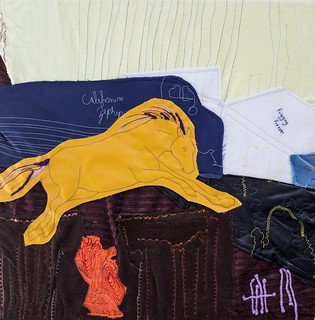
The second is an untitled piece, a square fabric collage was created for one of my classes at ACAD. The goal of the project was to spend one hour a night adding something to a large collage - whether it was adding a piece of material or embroidering a feeling. Now, I wish I had framed this one because it needed a lot of canned air and even then in the end I had to clone out a big, fluffy budgie feather I had missed. Fabric collage is really fun, but does require some forethought such as ironing all the pieces beforehand.
Saturday, October 17, 2015
Fancy Fashion at Lougheed House
My most recent visit to Lougheed House was a reminder that I don't visit enough. The last time I visited there was an art association in the basement and it has been a few years since they left! Lougheed House is really a local treasure. It's hard to imagine that it marked the edge of Calgary when it was built in 1891. It's actually remarkable that the grounds and house are still preserved. Locals know how Calgary is always in a constant state of construction.
Mom and I visited recently to catch the 1920s "Daring Deco" fashion show. I really enjoyed it because the dresses were once owned by Alberta women and it represented my great-grandmother and grandmother's era. I only have a few pictures of my great-grandmother, so to imagine that she may have once worn such fancy clothes was pretty cool. The 1920s don't really get a lot of appreciation - anything beyond 1950 is thought of as dull and bland sometimes. There were all sorts of exciting things happening such as new textiles, new music and new freedoms for women.
Textiles and clothing tell a silent, but ever present version of history. We wear clothes every day and special clothes for special occasions. Clothing conveys social status and wealth or personal history. Memories are stored in them. Studying clothes is more than meets the eye!
It took me a few moments to realize that the dresses were about 100 years old. That in itself is an amazing fact. Textiles aren't very good at surviving the ages. Pests, disaster, climate and poor storage all count against fabric. Natural fibres naturally degrade and wear and synthetic materials have an end of life too.
As a fibre major, I was thrilled to see a sample book of fabric to
touch. Fabric is so very tactile and taken for granted. Some of the
fabrics felt scratchy, but other ones were very plush and smooth.
Back to the house however - unlike some historic houses where the building and belongings pass from family to trust, Lougheed House had many lives as a women's military barracks and blood donor clinic, so the museum is in the process of repatriation. This isn't a disadvantage at all though - one can still enjoy admiring the architecture and decorations in the house like the stained glass windows and ornate ceilings. It's a lovely place to have a wedding or event, and yes, the staff can help you out with that :-)
The gardens are lovely to visit starting after the May long weekend, but there was much and even during autumn there was much to admire such as ornamental cabbages, rudbeckia and sweet Williams. Our main reason for visiting was to catch the 1920s fashion show - I will be sure to keep abreast of the events at Lougheed House in the future though. And I must return next summer and get some more iris photos.
The conservatory has been turned into a restaurant that is open for lunch on weekdays and brunch on weekends. It was delightful to have a cup of tea from a vintage tea cup :)
Mom and I finished our visit with brunch in the restaurant that used to
be the conservatory. It was so dainty to have tea from a vintage tea cup
and the staff were kind to let Mom and I split a bacon and waffle
breakfast (otherwise it would have been too much food for her). The brunch has a good variety of meals along with a feature dish. The restaurant staff
were fabulous and friendly. It's a good place to take small groups or friends. If you visit Lougheed House, check out some reviews on TripAdvisor and remember to show your AMA card and save on admission.
Mom and I visited recently to catch the 1920s "Daring Deco" fashion show. I really enjoyed it because the dresses were once owned by Alberta women and it represented my great-grandmother and grandmother's era. I only have a few pictures of my great-grandmother, so to imagine that she may have once worn such fancy clothes was pretty cool. The 1920s don't really get a lot of appreciation - anything beyond 1950 is thought of as dull and bland sometimes. There were all sorts of exciting things happening such as new textiles, new music and new freedoms for women.
Textiles and clothing tell a silent, but ever present version of history. We wear clothes every day and special clothes for special occasions. Clothing conveys social status and wealth or personal history. Memories are stored in them. Studying clothes is more than meets the eye!
It took me a few moments to realize that the dresses were about 100 years old. That in itself is an amazing fact. Textiles aren't very good at surviving the ages. Pests, disaster, climate and poor storage all count against fabric. Natural fibres naturally degrade and wear and synthetic materials have an end of life too.
As a fibre major, I was thrilled to see a sample book of fabric to
touch. Fabric is so very tactile and taken for granted. Some of the
fabrics felt scratchy, but other ones were very plush and smooth.
Back to the house however - unlike some historic houses where the building and belongings pass from family to trust, Lougheed House had many lives as a women's military barracks and blood donor clinic, so the museum is in the process of repatriation. This isn't a disadvantage at all though - one can still enjoy admiring the architecture and decorations in the house like the stained glass windows and ornate ceilings. It's a lovely place to have a wedding or event, and yes, the staff can help you out with that :-)
The gardens are lovely to visit starting after the May long weekend, but there was much and even during autumn there was much to admire such as ornamental cabbages, rudbeckia and sweet Williams. Our main reason for visiting was to catch the 1920s fashion show - I will be sure to keep abreast of the events at Lougheed House in the future though. And I must return next summer and get some more iris photos.
The conservatory has been turned into a restaurant that is open for lunch on weekdays and brunch on weekends. It was delightful to have a cup of tea from a vintage tea cup :)
Mom and I finished our visit with brunch in the restaurant that used to
be the conservatory. It was so dainty to have tea from a vintage tea cup
and the staff were kind to let Mom and I split a bacon and waffle
breakfast (otherwise it would have been too much food for her). The brunch has a good variety of meals along with a feature dish. The restaurant staff
were fabulous and friendly. It's a good place to take small groups or friends. If you visit Lougheed House, check out some reviews on TripAdvisor and remember to show your AMA card and save on admission.
Friday, December 27, 2013
So Much Catch Up!
I can't believe we're coming down to the end of 2013. I really don't know where fall went, except that it seemed like I was living each day in the present, not really able to plan for more than a week in advance. Certainly it was not a dull last few months...but it would be nice to get off the carousel :-)
I got an A- in my Fibre 212 class. I find it harder to get A's in studio classes I just never seem to have what teachers are looking for. But with Laura as a guide, I found myself making all sorts of new and interesting things, stuff I wouldn't try on my own.
Our last project was to make a home installation, and then the plan was that we would all go around and view each one. Unfortunately we had a frightful blizzard here at the beginning of the month that slowed everything down. It was taking two hours to get to work and back :S Instead, my classmates and I did our best to take pictures of the installations. Thank goodness for my new camera, because my old one would not have been able to handle the poor lighting so well.
I was really looking forward to having my classmates over. I bought a lot of snacks, told hubs, "Hands off!" and made punch even! Needless to say, I now have a lot of good reference photos for still lifes and the project ended up being more than I expected. You can click on the photo below to see the whole set up!
Subscribe to:
Posts (Atom)